
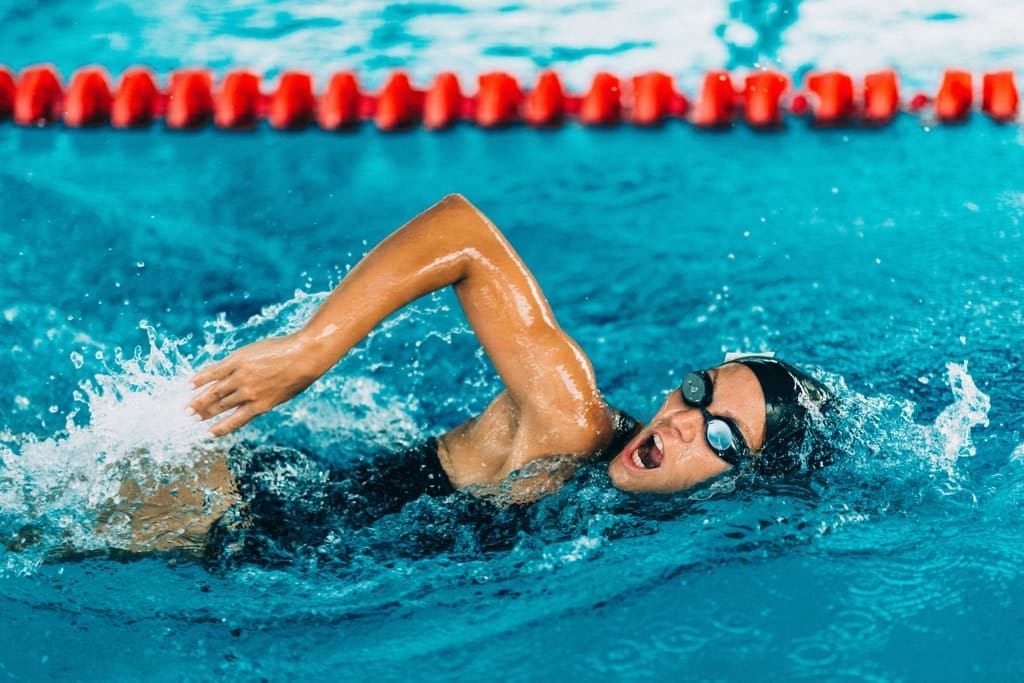
Tips for Breathing While Swimming
Swimming is the most physically demanding aerobic activity for the primary reason of finding time to breathe! Often times we feel as if we are choking, panting, or gulping water instead of getting in a nice, relaxed and fluid breath. Proper breathing technique for novice swimmers is often 90% of the challenge when learning how to swim. Since swimming is a full-body, coordinated effort we need to find proper time to get oxygen to our working muscles and cardiovascular system. A proper breathing pattern occurs as part of your long axis of rotation. Here we’ll discuss several skills for better breathing while swimming.
LET’S BLOW BUBBLES, SHALL WE?
Believe it or not, blowing bubbles in the water as your exhale is the best way to develop a proper breathing pattern. This is especially beneficial if you find yourself holding your breath as you move through the water. By blowing bubbles, you will also be preoccupied on something else so you can further help get all the other mechanics of swimming in check. Standing at one end of the pool, place your face in the water and count to 5 and pivot your head to the right or left side, whichever is your personal preference. Do this about 5-6 times. Remember to inhale through your mouth and exhale through both your nose and mouth. As you are standing with your head in the water, practice and focus on the control you have with a relaxed, full breath into your system. Be patient — swimming takes practice as does learning how to control and develop a proper breathing pattern.
WHERE ARE THE FISH?
As your body rotates with forward movement, you should need to turn your head only slightly to get a full comfortable breath. Your gaze should be about 5 degrees above the imaginary line of the water that your body is swimming on. Your head should not have to be forced to rotate when taking a breath. The turn of your head should be at a 90 degree to the bottom of the pool or whatever type of body of water you are swimming in. Each time your head returns back to the water, exhale completely. As your head rotates for breath, there should be a full and smooth inhale. The shorter the breath, the quicker you will put yourself into oxygen deprivation. Try to visualise yourself as relaxed as possible just like those fish in the lake you will see this summer!
BILATERAL BREATHING MEANS BILATERAL SWIMMING
With freestyle swimming, there are two types of breathing patterns: single-sided and bilateral breathing. Single-sided is always breathing on the same side. Bilateral breathing means turning alternately to the right side, and then to the left, for a breath of fresh air. Once you are comfortable with a breathing pattern, you will find there are some advantages of bilateral breathing: it evens out your stroke, helps you rotate evenly on both sides and limits the amount of drag you are producing in the water. I encourage you to use it as often as possible in both training and competition, especially on days when you’re practicing good body symmetry. Your breathing pattern will further set your pace for your race.
PRACTICE MAKES BREATHING EASY
Learning proper breathing patterns will be your biggest challenge for a more efficient swim pattern in the water. Be patient. PRACTICE! It takes time to build proper technique and efficiency. If you have a lot on your mind when you enter the pool, don’t let your breathing pattern become one more thing to worry about. Make sure your breathing is smooth and fluid with each stroke you take. Remember, you can only get better.
BREATHING DRILLS
- Single-side breathing
- Bilateral breathing
- Hypoxic breathing (only do this once you are confident and efficient with your current level of breathing pattern! Don’t create more work for yourself!) Increase your breathing pattern to every four, five or six strokes instead of alternating as you would with bilateral breathing. This should be done in 25’s or 50’s as speed work in your swim workout.